Charlie Elk

pseudonym of a man

  • News
  • Think Pieces / Opinion
  • Turkey Hunting
    • Fall Turkey
    • Spring Turkey
    • turkey hunting tips
    • Stories
  • Humor
  • Deer Hunting
  • Willow Ridge Custom Turkey Calls

CWD Infects Bucks Twice the Rate of Does

March 7, 2015 by Charlie Leave a Comment

courtesy Green Bay Press Gazette

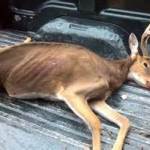
CWD-infected buck. Courtesy Green Bay Press Gazette

The rate of CWD infection continues to increase in Wisconsin’s deer herd.  Whitetail bucks 2.5 years old and up have a higher rate of infection according to the most recent sampling.

Statewide in 2014 5,400 deer were sampled for CWD.  324 deer were found CWD positive mostly in Wisconsin’s southern endemic area this is a 6% infection rate.

The infected deer by age and sex-

  • 25% – adult male white-tailed deer (2.5+ years-old)
  •   8% –  yearling males
  • 10% – adult female deer
  •   7% – yearling females

Since the beginning of sampling in 2002 CWD infection have continued to increase mainly among bucks 2.5 years and older.  The best hypothesis regarding the spread of CWD is that it is spread via body fluids containing the prion.  Many researchers believe this is due to the natural behavior of the adult buck.

  • Creating and maintaining  scrapes,
  • Licking branches to leave a scent that is then licked by other bucks and some does.
  • Adult bucks wander a wider geographic area which risks spreading CWD to new areas.

So far, research indicates the best thing to do to contain or at least slow CWD’s  progress is reduce the herd density while removing as many 2.5-year-old bucks as possible. The problem with implementing this strategy is hunter opposition. During the last couple of decades, hunters have come to believe they should let small bucks pass in order to grow them up for bigger antlers, referred to as Quality Deer Management  (QDM).  When CWD was first discovered in Wisconsin, the DNR set in motion a deer extermination policy in the believe they could eliminate all CWD-infected deer in what has become known as the CWD Zone.   During this failed effort a system known as Earn a Buck (EAB) was instituted.  However, according to the documented infection rates an Earn a Doe (EAD) should have implemented instead.  Assuming the infection rates by age and sex above it makes more sense to push down the buck population. A lower population of bucks may keep bucks in the area.  When bucks become crowded in an area, some move-out or are pushed out by dominate bucks.  Causing a certain number of bucks, some which could be infected to move on and infect new areas.

According to Tami Ryan, DNR wildlife health section chief.

“Long-term monitoring of disease patterns is crucial in understanding the dynamics of this CWD, and it’s also important to make sure we keep the public informed, prevalence continues to increase within the department’s long-term monitoring area in Southwest Wisconsin, and remains higher in males than females and higher in adults than yearlings.”

“The department is very grateful for the cooperation that hunters and landowners have provided over 13 years of sampling, they are helping monitor the health of Wisconsin’s deer herds and providing information that is of interest to many.”

WDNR statements regarding CWD monitoring.

Monitoring efforts also included ongoing surveillance within a 10-mile radius of the each new positive found in 2012 in Juneau, Adams and Portage counties in central Wisconsin. Four additional positives were found in 2013 in Adams and Portage counties, while two additional positives were discovered in Adams County in 2014.

Surveillance was also conducted surrounding a CWD-positive captive deer farm in Marathon County, with no wild CWD deer detected.

Following the 2012 discovery of a CWD-positive adult doe near Shell Lake, 2014 marked the third year of surveillance efforts in Washburn County in Northwest Wisconsin. Following recommendations from a local community action team, local landowners and hunters helped the department sample more than 1,900 deer in the area over the last three years. No new positives have been detected. Based on three years of sampling, all information has indicated CWD is not widespread in the Washburn area, and occurs at a very low prevalence rate.


CWD infected Doe. Courtesy WDNR

CWD-infected Doe.
Courtesy WDNR

Filed Under: Deer Hunting, News Tagged With: Chronic Wasting Disease, cwd, hunting, news, Wisconsin deer

Is Quality Deer Management Theory Destroying Wisconsin’s Deer Herd?

February 25, 2014 by Charlie 1 Comment

Test results provide current snapshot of CWD in south-central Wisconsin

For 12 years WDNR has had ongoing CWD surveillance efforts, Department of Natural Resources officials maintain a current picture of trends and

To stop CWD should we focus on removing the older bucks?

To stop CWD should we focus on removing the older bucks?

prevalence of chronic wasting disease within the area previously known as the Wisconsin CWD zone map in the southern part of the state.

The Prevalence of CWD has increased in all categories- Based on 2013 test results for the western monitoring area, encompassing western Dane and Eastern Iowa counties where sampling has been occurring annually since the disease was discovered, current prevalence is:

  • 25 percent of adult male white-tailed deer
  • 10 percent of adult female deer
  • about 7 percent of yearling males
  • about 6 percent of yearling females

All the CWD research has shown, very clearly that adult bucks are more likely to be infected. WDNR’s 12 years of CWD surveillance proves this yet again.  CWD infects 1 out of 4 adult bucks and if yearling bucks are included 1 in every three bucks are infected compared to 1 out of 6 female deer are infected. The research demonstrates: If the goal is to reduce the incident of CWD adult bucks should be removed from the deer herd.  So instead of “earn a buck” there should have been “earn a doe”.   Is it time to target bucks for removal or is it too late?

A rational person could conclude quality deer management theory is destroying Wisconsin’s deer herd.  Why? The emphasis of quality deer management is on preserving bucks and letting them grow older to 3-6-year-olds before killing them.  These 3-6 years old bucks have a much greater chance of carrying CWD, and these are the deer that migrate into new territories spreading their CWD infection as they go.

Tami Ryan, DNR Wildlife Health section chief-

“Sampling deer from these areas where there has been long-term monitoring of disease patterns is important to understanding the dynamics of this disease,” . “Prevalence has been increasing as expected, and we continue to find that prevalence is higher in males than females and higher in adults than yearlings.”

In 2013, DNR staff tested deer from within and outside of the CWD-MZ in south central and southeastern Wisconsin. The sampling strategies were aimed at detecting changes in the location and trends in the prevalence of the disease. Monitoring plans focused surveillance on adult deer, which are most likely to have the disease.

Beginning in 2014, with the approval of the Deer Trustee Report rule package, DNR will have a new funding source available beginning this fall to provide hunter service testing statewide. The funding comes from having the authority to apply $5 from each additional antlerless deer permit sale in CWD-affected counties towards CWD testing and monitoring.

Tami Ryan, DNR Wildlife Health section chief-

“Prior to this change, DNR received no money from additional permits sales. We are pleased to now have a consistent funding stream for CWD testing and monitoring,”

Also emerging from the rule is the Deer Management Assistance Program and the formation of county deer committees, both of which give DNR flexibility to work locally to develop cooperative approaches to disease surveillance and management.

Tami Ryan, DNR Wildlife Health section chief-

“It’s important to be able to work cooperatively with hunters and landowners, as their participation is essential to CWD surveillance. It’s also very important that we connect with the local communities so they can stay informed on deer disease and DNR’s approach to monitoring. They are also the conduit for public sentiment, sharing information with us in addition to taking information back to their community.”

CWD-buckIn spite of the evidence, we are still going to target antlerless deer when the science proves; if the goal is to stop CWD, the population of male deer needs to be reduced. Perhaps this won’t help the deer in the CWD zones, but it sure would stop those wandering bucks from leaving the area and infecting the rest of Wisconsin’s deer.

Filed Under: News, Think Pieces / Opinion Tagged With: cwd, deer, deer hunting, WI deer hunting, Wisconsin deer

Subscribe to Blog via Email

Enter your email address to subscribe and receive notifications of new posts by email. No other email will be sent to you.

comments

  • Justin on Bulllet Head Stamp Gallery
  • Kathy Eldred on Beavers Eat and Store Corn
  • Toney Jacob on Hunting Deer From the Ground in Wisconsin
  • Anthony Lumbard on Bulllet Head Stamp Gallery
  • Bryan Ash on Wild Turkeys See In Color; But Will Pink Spook Them?
  • Jim Sinquefield on How to Legally Bait Wild Turkeys

Top Posts

  • What do Wild Turkeys Eat?  Crops tell the story
    What do Wild Turkeys Eat? Crops tell the story
  • How to Ask for Hunting Permission
    How to Ask for Hunting Permission
  • Wild Turkeys See In Color; But Will Pink Spook Them?
    Wild Turkeys See In Color; But Will Pink Spook Them?
  • What Ate My Deer?
    What Ate My Deer?
  • When Do Turkeys Nest in Wisconsin?
    When Do Turkeys Nest in Wisconsin?
  • Wisconsin State Senate Schedules Crossbow Hearing
    Wisconsin State Senate Schedules Crossbow Hearing
  • To Protect the Young - Sassy Hen Sashaying in The Corn Video
    To Protect the Young - Sassy Hen Sashaying in The Corn Video
  • Wisconsin Collector Stamps; How to order
    Wisconsin Collector Stamps; How to order

Recent Posts

  • Kirkland Warbler, Wild Turkey use Audio Bait
  • A Little more Frigid or Warm; What is better for Wildlife?
  • West Nile Virus detected in Wisconsin Ruffed Grouse
  • When the Deer Season Ends
  • First Bubba Chili Pucks

Recent comments

  • Justin on Bulllet Head Stamp Gallery
  • Kathy Eldred on Beavers Eat and Store Corn
  • Toney Jacob on Hunting Deer From the Ground in Wisconsin
  • Anthony Lumbard on Bulllet Head Stamp Gallery
  • Bryan Ash on Wild Turkeys See In Color; But Will Pink Spook Them?

Videos

Mosquitoes use six needles to suck our … [Read More...]

Have you ever had a whitetail deer standing real … [Read More...]

Copyright © 2025 charlie elk


Loading Comments...